







New and seasoned investors often ask:which is better,stocks or gold?In 2026,with persistent inflation,shifting monetary policies and ongoing market uncertainty,this question is more relevant than ever.The truth is,these two assets serve completely different portfolio purposes.Stocks focus on long-term growth,while gold specializes in risk hedging and value preservation.A clear understanding of their differences helps you build a stable,goal-aligned investment portfolio.
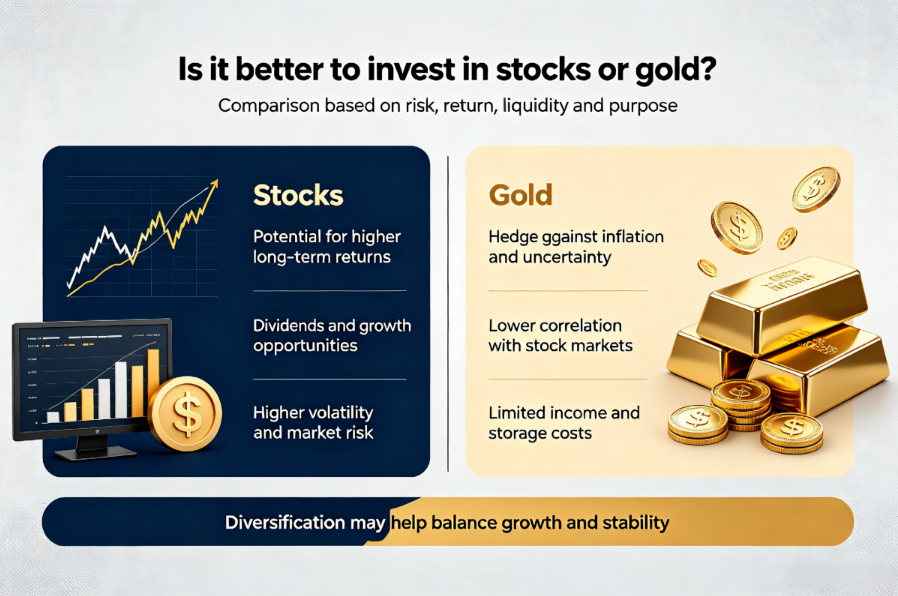
Stocks:The Core of Long-Term Compound Growth
Stocks are the primary choice for investors pursuing long-term wealth growth.Backed by corporate profitability and industry expansion,equities deliver steady compound returns over time,easily outperforming most traditional safe-haven assets.Most stocks and equity ETFs also provide dividend income,bringing investors dual gains of capital appreciation and passive cash flow.Meanwhile,stock trading features high liquidity and no physical storage costs,making it flexible for long-term holding and short-term trading.
However,stocks carry obvious volatility risks.They are highly sensitive to economic recessions,market sentiment and corporate performance.Sharp short-term pullbacks are common during market crashes,which means stock-heavy portfolios are not suitable for conservative investors or those with short investment timelines.
Gold:The Timeless Safe-Haven Hedge
Gold is a classic safe-haven asset that has preserved wealth for thousands of years.Unlike stocks,it has no counterparty risk and resists inflation,currency depreciation and geopolitical turmoil.When global markets fall sharply and stock assets suffer losses,gold often maintains stable or even rising prices,acting as an effective portfolio hedge against systemic risks.
Yet gold has inherent flaws for growth investing.It generates no dividends,interest or compound returns,and its price fluctuations rely solely on market sentiment and macro trends.In long-term bull markets,gold’s return is far lower than diversified stock portfolios.Physical gold also involves extra storage and insurance costs,limiting its flexibility for regular trading.
The Smart Verdict:It’s Not Either/Or,It’s Both
There is no need to choose strictly between stocks and gold.Professional investors always adopt a collocation strategy:stocks drive long-term asset growth,while gold hedges short-term market risks.This diversified allocation balances growth potential and asset security,allowing portfolios to adapt to both economic expansion and market downturns.
While stocks and gold complement each other in a diversified portfolio,investors need professional,dedicated channels to trade gold efficiently as a core hedging asset.A specialized,compliant precious metals trading platform delivers safer,more efficient gold allocation,helping investors hedge stock market risks and optimize their portfolio structure in a timely manner.
Trade Gold Professionally with UPWAY Global
UPWAY Global (https://www.jrjr.com/en/?340) is a professional,compliant global platform focused on precious metals investment.With years of industry experience and authoritative regulatory qualifications,it provides pure,secure gold trading services for global investors,catering to both novice traders and experienced market participants.
The platform features competitive trading costs,real-time global gold market quotes,and stable trade execution,allowing users to seize optimal hedging and allocation opportunities.It fully supports flexible gold position adjustment,perfectly matching the needs of investors who hedge stock market volatility and balance portfolio risks.
In addition,UPWAY Global provides professional precious metals market analysis and practical portfolio hedging tools,helping users grasp the correlation between gold and stock markets,formulate reasonable asset allocation strategies,and effectively offset equity market downside risks.
Final Thoughts
Stocks and gold play irreplaceable complementary roles in investment.Stocks drive long-term portfolio growth,while gold acts as a reliable risk hedge to resist market volatility.
Disclaimer:This content is for informational purposes only and should not be construed as financial advice.