







Every month,US Consumer Price Index(CPI)releases trigger sharp swings across global financial markets,and spot gold(XAUUSD)is often one of the most actively traded instruments during these events.Many new traders wonder exactly how inflation figures move gold prices,and why the market sometimes reacts in seemingly counterintuitive ways.To understand gold’s volatility around CPI,we need to unpack the full chain of market expectations,central bank policy and real yields.
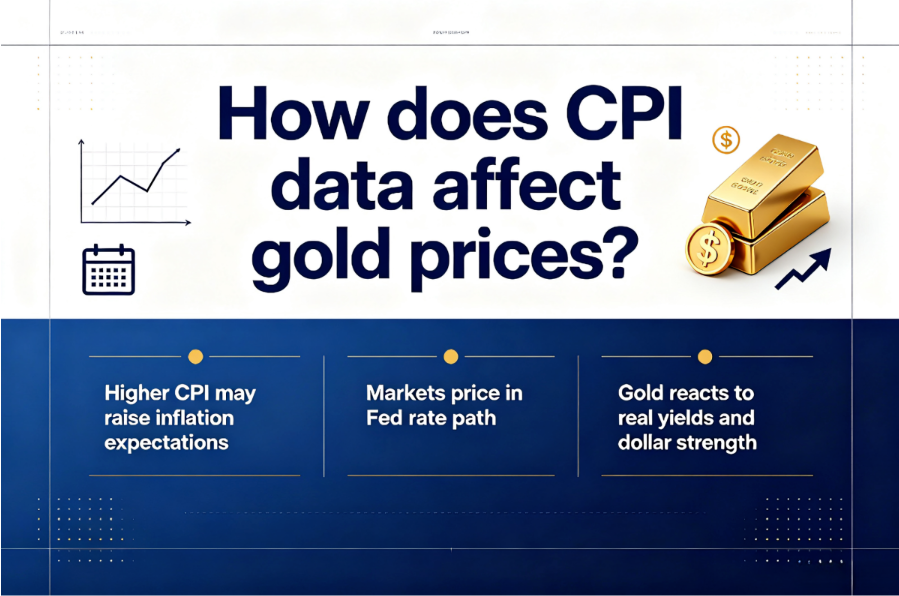
At its core,gold carries no interest or dividend.The primary cost of owning gold is the return investors give up by not holding interest-bearing assets such as US Treasury bonds.This opportunity cost is measured by real interest rates—nominal bond yields minus inflation expectations.CPI is the key official gauge tracking inflation pressure,so every print directly reshapes forecasts for real yields,the US dollar and Federal Reserve policy.
We can break down two typical market scenarios.
First,hotter-than-expected CPI.Persistently high inflation forces the Fed to maintain tight monetary policy,keeping interest rates elevated.Higher real yields raise the appeal of dollar-denominated fixed-income assets.In many cases,this strengthens the US dollar and weighs on gold,even though gold is widely viewed as an inflation hedge.Traders often overlook this nuance:gold hedges long-term devaluation of fiat currency,but aggressive rate hikes can suppress bullion prices in the short run.
Second,cooler-than-forecast CPI.When inflation cools faster than economists predict,markets begin pricing in potential rate cuts or an end to rate hikes.Expected real yields trend lower,reducing the opportunity cost of holding non-yielding gold.The US dollar frequently weakens as capital seeks alternative assets,creating favourable conditions for gold to rally.
It is vital to note that headline CPI alone never tells the whole story.Market participants pay close attention to core CPI,which strips out volatile food and energy costs.A strong headline figure paired with soft core inflation can trigger mixed price action.Meanwhile,post-data commentary from Fed officials can quickly reverse initial market moves.Even after a bullish CPI print for gold,hawkish remarks about keeping rates high may erase gains within hours.
Timing also matters greatly.Price volatility often peaks in the minutes immediately after the CPI release,driven by algorithmic orders and fast speculative flows.Amateur traders frequently fall victim to exaggerated short-term swings without a clear trading plan.Successful market participants track consensus forecasts in advance,define risk limits and avoid impulsive entries during peak volatility.
For those aiming to trade gold around major macroeconomic events like CPI,having reliable market access and robust analytical tools makes a tangible difference.Many active traders choose UPWAY Global (https://www.jrjr.com/en/?340) to monitor real-time XAUUSD pricing,track economic calendars and execute trades seamlessly across market-moving data releases.The platform delivers streamlined access to precious metals markets,supporting traders who build strategies centred on inflation data and broader macro trends.
Gold trading around CPI carries inherent risks due to fast liquidity shifts and widened volatility.No single economic indicator guarantees a fixed price direction.Seasoned investors combine inflation readings with US dollar trends,yield curves and geopolitical developments to form balanced outlooks.
As inflation remains a central theme for global monetary policy,monthly CPI prints will continue generating trading opportunities in the gold market.Learning to interpret inflation data objectively,rather than relying on simplistic assumptions,helps traders navigate volatile sessions and make more informed decisions amid rapidly shifting market sentiment.
Disclaimer:This content is for informational purposes only and should not be construed as financial advice.