







Gold has long stood out as a trusted safe-haven asset, valued by central banks, institutions and retail investors alike. Unlike stocks that trade only during exchange hours, the global gold market runs nearly around the clock, woven together by several major trading hubs across different time zones. Understanding these core markets helps traders follow price flows and grasp where global gold pricing is formed.
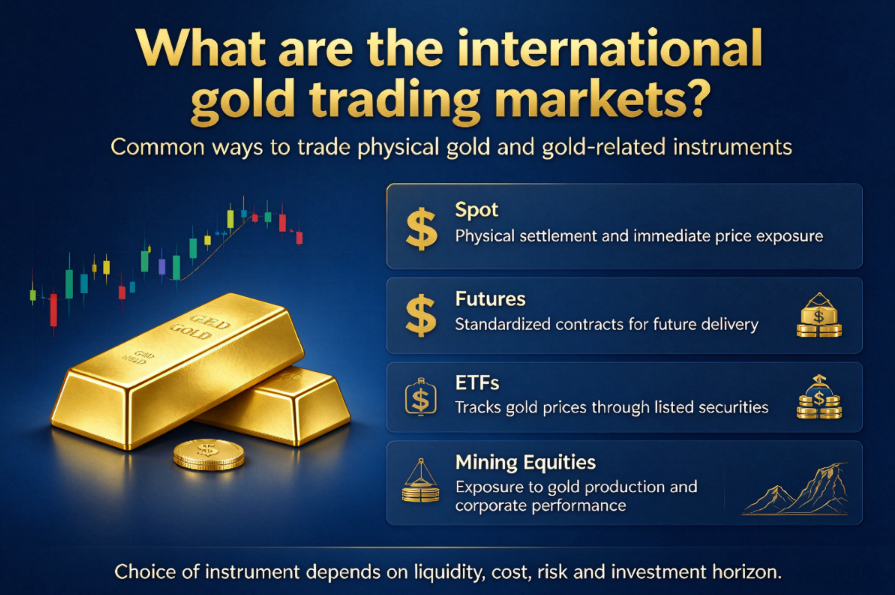
The London OTC bullion market remains the backbone of international spot gold trading. It handles the largest share of global gold turnover and publishes the LBMA Gold Price twice each day, widely adopted as the global spot benchmark. This over-the-counter market connects bullion banks, refiners and institutional participants, with deep liquidity for large spot and forward contracts.
Next is COMEX in New York, the dominant venue for gold futures and options. Futures activity here drives short-term price swings, especially during US trading sessions. Many active traders watch COMEX closely, as futures flows often trigger sharp intraday moves in spot gold.
Other influential hubs support the global network. Zurich has built a reputation for physical gold storage and refining, with a long history of confidential bullion services. The Shanghai Gold Exchange focuses heavily on physical gold delivery and serves fast-growing Asian demand, while regional centres including Hong Kong, Singapore and Dubai fill timezone gaps and cater to local investor groups.
Taken together, these markets form a continuous trading cycle. As London winds down, New York opens; when US trading closes, Asian markets pick up momentum. This 24-hour rhythm means gold prices keep responding to news, inflation data and central bank announcements almost nonstop.
For retail investors, gaining reliable access to these interlinked global markets matters more than simply knowing their names. A well-regulated gateway can simplify the process of tracking spot gold prices and executing trades across international liquidity pools. UPWAY Global offers traders streamlined access to international precious metals markets, built on stable infrastructure and transparent trade records. It suits those who want to follow London spot pricing and trade with consistent market connectivity, whether you are new to gold or an experienced market participant.
Before you start trading, it is always wise to learn about market volatility, set clear risk rules and avoid overexposure. Gold can hedge against market uncertainty, yet its price still moves sharply amid macroeconomic shifts. Take time to study market cycles and build your trading plan step by step.
Disclaimer:This content is for informational purposes only and should not be construed as financial advice.